For years I told my own customers to wait — for cheaper batteries, smarter software, simpler installs. I’m not saying that anymore. The technology is here, the pricing is right, Rocky Mountain Power just gutted what they pay for solar exports, and outages keep getting longer. Backing up your own home — and using your own power instead of giving it away — is the move now.
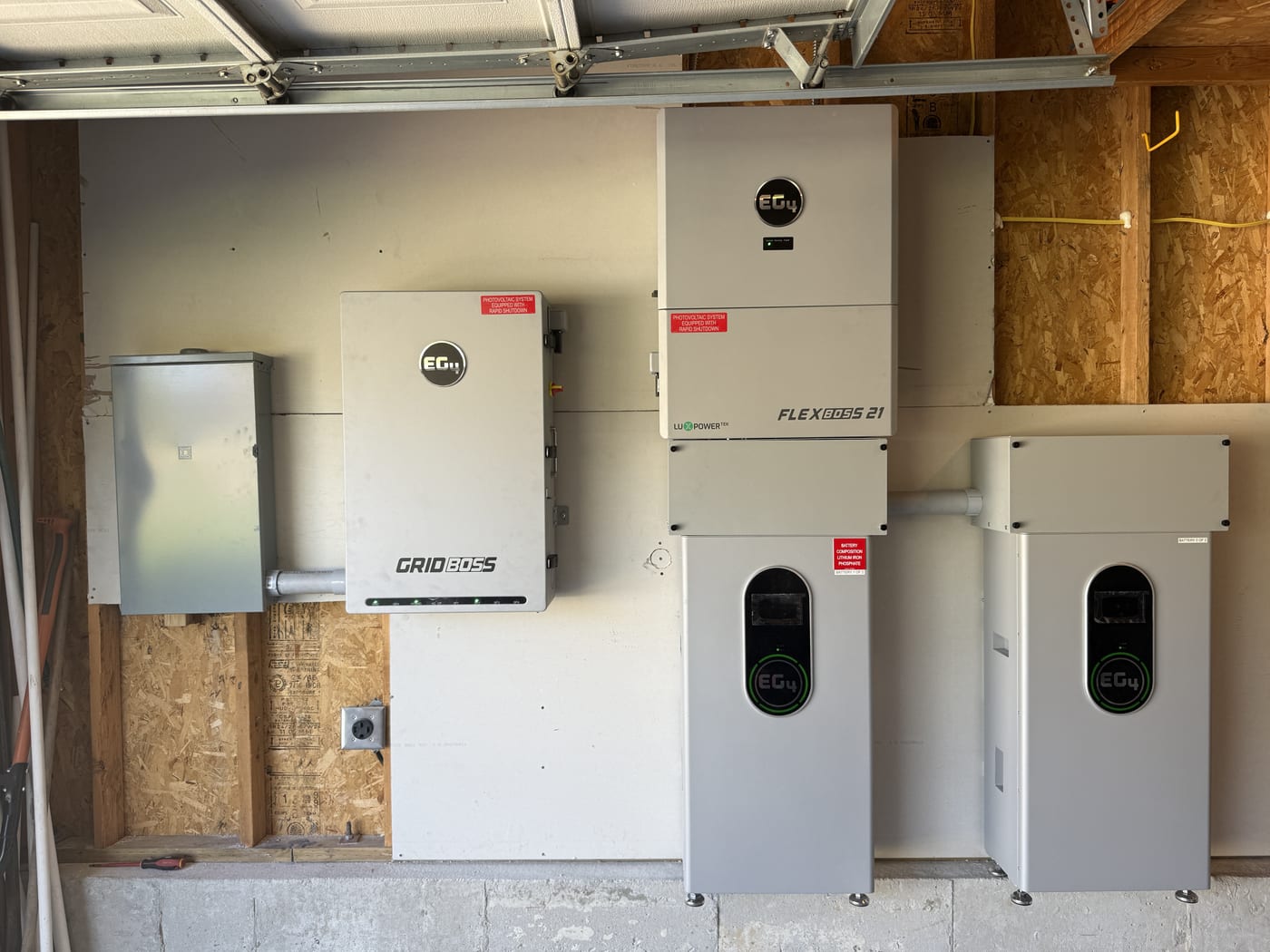
Whole-home battery backup is a permanent home battery system that powers your entire electrical panel during a grid outage. In Utah, it typically pairs a 10–30 kWh lithium-ion battery (Tesla Powerwall 3, Sigenergy SigenStor, or EG4) with an automatic transfer switch, so when Rocky Mountain Power goes down, your house keeps running with no generator noise, no fuel, and no manual switching.
During normal grid hours, the battery charges from your solar panels (or the grid at off-peak rates). When the grid drops, an automatic transfer switch disconnects your house from utility power in about 20 milliseconds and the battery takes over. Most Utah homeowners can run essentials — lights, fridge, internet, furnace fan — for 12–24 hours on a single battery; longer with multiple batteries or paired solar.
Tesla Powerwall 3 starts at $9,995 net after $2,500 in stacked Wattsmart and Tesla rebates. Sigenergy SigenStor from $12,500 (no rebate). EG4 from $14,000 (no rebate). All prices include installation, transfer switch, permits, and commissioning by a licensed Master Electrician.
Three things shifted at the same time. Together they ended a decade-long “wait and see.”
Modern LFP batteries pack the energy of three or four 2018-era units in a single wall-mount. One battery now backs up a whole Utah home. Stack two and you cover a 24-hour outage with AC running.
Tesla Powerwall, EG4, and SigEnergy are now within a few thousand dollars of each other on a fully-installed basis. The price floor has dropped to where a single battery starts at $12,000 — roughly half what dealer networks were quoting two years ago.
Rocky Mountain Power’s new export rates pay roughly $0.05/kWh for solar you push to the grid — while charging $0.11+ to buy it back. Without storage you give power away cheap. With a battery you keep every kWh at full retail value. Outages are also up: 2024 had Utah’s most weather outages in a decade.
Every BYOP install is a whole-panel backup — no critical-load sub-panels, no circuit re-routing. Each brand below uses LFP chemistry, ships with a 10-year warranty, and qualifies for the $2,000 Wattsmart rebate per battery.
13.5 kWh first system. +$6,500 per additional 13.5 kWh battery.
16 kWh first system. +$4,000 per additional 16 kWh module.
9 kWh first system. +$3,000 per additional 9 kWh module.
Not sure which fits? Use the calculator below or call (385) 283-7904. Pricing reflects fully-installed cost — equipment, automatic transfer switch, panel work, permit, inspection, commissioning. The $2,000 Wattsmart rebate per battery is applied directly to the project cost.
Tell us about your home. We’ll size the system honestly and show what each brand costs at that capacity. Final number requires a panel check — this is the napkin math.
Rocky Mountain Power pays $2,000 flat per battery when you enroll. In exchange, RMP can draw a small portion of stored energy during peak demand events — never below your reserved backup. We apply the rebate directly to your project cost. It never lands in our pocket.
Quick answers. If yours isn’t here, call or text (385) 283-7904.
For years the honest advice was to wait — batteries were small, software was rough, and exporting solar to the grid paid well. All three have flipped. Modern LFP batteries pack 13–16 kWh in one cabinet, the install playbook is mature, and Rocky Mountain Power’s new export rates make storing your own solar far more valuable than selling it back. Combined with longer, more frequent outages, the math now favors installing rather than waiting.
Tesla Powerwall 3 is the easiest entry point — lowest first-system price, the most polished app, and the brand homeowners know. EG4 is the best $/kWh once you’re scaling past one battery; the additional 16 kWh modules are the cheapest extra capacity on the market. SigEnergy is the most innovative — smallest scaling increment (9 kWh), AI-driven optimization, and built-in EV-charging integration on the roadmap. We’ll recommend the right fit based on your load, panel condition, and how much you plan to grow.
It’s strongly recommended. Modern residential batteries ship with an MPPT solar inverter built in — installing without solar means paying for hardware that sits unused and losing the daily bill savings that make the battery pay for itself. With solar included, you also qualify for the $2,000 Wattsmart rebate per battery. If you genuinely don’t want solar, a standby generator is the honest recommendation.
RMP’s net-metering successor program now pays roughly $0.05/kWh for solar exports while charging $0.11+/kWh for power you import. Without storage, you give power away cheap and buy it back expensive. With a battery, you store your midday solar and run your house on it during peak hours — keeping the full retail value of every kWh your panels produce. Storage went from a nice-to-have to the thing that makes solar economics work.
Free site visit and quote in week 1. Permit and equipment ordered in week 2. Install is typically 1–2 days on site for a single-battery system, 2–3 days for a stacked system. Inspection and commissioning happen the same week as install. From signed quote to powered-on backup is usually 3–5 weeks depending on city permit queue.
The federal residential ITC expired December 31, 2025. Standalone battery storage no longer qualifies for a federal credit. The $2,000 Wattsmart rebate from Rocky Mountain Power is still active and is the best available incentive for battery backup in Utah.
No salespeople. No leases. No dealer markup. Just a licensed Master Electrician giving you a straight number on what backup costs, how long it’ll run your home, and which brand fits.